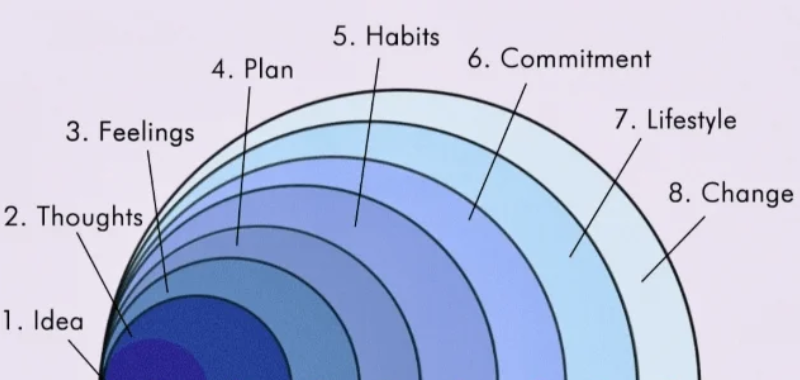
Change starts with an idea, but an idea alone doesn’t change behavior
When we want something in our lives to be different, it usually starts with an idea. We realize that something is no longer working for us, identify a habit we would like to change, or imagine a different way of responding. But there is a process between understanding what we want and actually changing. Knowing what we should do is not always enough to make us do it. We can know that physical activity is important and still not exercise, understand that we need more sleep and still stay up late, or recognize that avoiding certain activities is limiting us and still continue to avoid them. Behavioral change happens when an idea becomes an action, and that action is repeated enough times to gradually become part of the way we live.
What happens when an idea becomes an action?
One thing that can help turn an intention into action is planning not only what we want to do, but also when and under what circumstances we will do it. In behavioral research, this is sometimes referred to as an “if–then plan”: if a certain situation happens, then I will take a specific action. For example: “If I finish my morning coffee, I will do five minutes of exercise.” The idea is simple, but it changes something important. Instead of leaving the action to a decision we have to make every time, we create a connection in advance between a specific situation and a specific behavior. Research on these types of plans suggests that they can help people translate intentions into actual behavior.
Why can a small action be meaningful?
When we think about change, it is easy to imagine something big: starting to exercise five times a week, completely changing our daily routine, or suddenly stopping a habit we have had for years. But meaningful change does not have to begin dramatically. Sometimes a small action is a better starting point because it allows us to experience success and build consistency. Five minutes of exercise will not immediately become a lasting habit, but five minutes repeated again and again can be very different from making a big decision once and then abandoning it.
Research on habit formation shows that developing a habit is a gradual process, and the amount of time it takes varies considerably between people and behaviors. In a well-known study by Lally and colleagues, the median time it took for a behavior to become more automatic was 66 days, but the range between participants was very wide. In other words, there is no magic number of days after which a habit is simply “formed.” What matters is repeating the behavior in a similar context over time.
The brain learns through repetition
When we repeat an action again and again, it can gradually become less dependent on conscious effort. This is one reason habits can become so powerful. We wake up and brush our teeth without having to consciously decide whether we are going to do it, walk into the kitchen and make coffee, or get into the car and put on our seatbelt. The context itself can become a cue that triggers the behavior.
But the same process can work in the other direction. If we avoid a particular activity for a long time, avoidance itself can become a familiar pattern. That is why change is not always about having more “willpower.” Sometimes we need to create repeated opportunities to experience and practice a different behavior.
Change is not just about creating a habit
Even when a new action begins to become a habit, the process is not over. Behavioral change that lasts over time is also influenced by our environment, personal goals, ability to deal with obstacles, and whether the new behavior actually fits into our lives.
This is where self-efficacy also becomes relevant — the belief that we are capable of carrying out an action and dealing with situations that may make it more difficult. Self-efficacy does not mean believing that “anything is possible.” It develops through experience. When someone succeeds in doing something that was previously difficult, even on a small scale, they gain new information about their own abilities. That experience can support the next attempt.
Sometimes, therefore, the more useful question is not “Can I make this entire change?” but “What is the next step I can take right now?”
What happens when we have a setback?
Almost every process of change includes days when things do not go according to plan. We may miss a workout, temporarily return to an old habit, stop practicing for a week, or feel as though our progress has disappeared.
It can be tempting to interpret this as failure: “I’m back where I started.” But one missed opportunity does not erase everything that came before it. Research on habit formation has found that missing an opportunity to perform a behavior does not necessarily have a significant effect on the overall process of habit formation.
An important part of change, therefore, is not only the ability to start, but the ability to return.
And how does all of this relate to pain?
When pain persists for a long time, it can affect more than the sensation itself. It can also influence the way a person behaves around pain.
People living with persistent pain may gradually begin avoiding certain movements, changing the way they perform everyday activities, repeatedly checking what their body is feeling, resting more, or reducing activities that were once part of their lives. Sometimes they begin planning their day around pain or making decisions based on an attempt to prevent a possible flare-up.
These patterns do not develop because someone simply “chooses” to be afraid or avoidant. They can develop gradually through repeated experiences with pain and through the body’s attempts to protect itself.
Persistent pain and neuroplasticity
This is where neuroplasticity also becomes relevant — the ability of the brain and nervous system to change in response to experience and learning. When pain persists over time, research has identified changes in the way the brain and nervous system process and regulate pain. Neuroimaging studies have also found structural and functional changes in different brain regions and networks in people with chronic pain.
It is important to emphasize that these findings are not the same for everyone, and they do not mean that every person with chronic pain will develop the same changes. They do, however, help us understand that persistent pain is not simply a local experience occurring in one painful body part. It involves complex nervous system processes that can change over time.
This is also where the connection between the brain, the nervous system, and chronic pain becomes important. read more about the connection in my article → “No Brain, No Pain, beyond the tissue”
Change in the way we respond to pain does not necessarily have to begin with trying to eliminate every uncomfortable sensation. Sometimes it begins by creating a new experience: gradually returning to an activity we have been avoiding, changing the way we respond to a sensation, or rebuilding the ability to do something that matters to us.
In this sense, change is not simply about “thinking differently.” It also involves learning through experience. When we repeatedly practice a new behavior under appropriate conditions, we give the nervous system an opportunity to learn something different.
This does not mean ignoring pain or pushing the body through it. It means gradually exploring what is possible, adjusting the level of activity, and allowing new experiences to become part of life over time. For example, responding differently when pain appears during exercise can be part of this process. if you deal with pain during Exercise, read my article about it → “Pain During Exercise” – What to Do and Not Do When Pain Appears.
Change that can last over time
One of the most important parts of changing a behavior is finding an approach that can continue even after the initial motivation decreases. Motivation can change from one day to the next, while habits can rely more on routines, the environment, and actions that have already become part of our day.
That is why meaningful change does not always look dramatic from the outside. Sometimes it looks like another short walk, another practice session, another attempt to climb the stairs, or another activity that we used to avoid.
Then, after some time, we look back and realize that things are no longer happening exactly the way they used to.
From an idea to a habit, and from a habit to a life
Change may begin with an idea, but it becomes reality through action. An idea creates direction, planning helps turn it into action, repetition makes a behavior more familiar, experience builds self-efficacy, and consistency allows the process to continue even when things do not always go according to plan.
In the context of persistent pain, change may not only be about how often pain appears. It can also be about what a person is able to do when pain is present.
Sometimes change begins when we stop asking only, “How do I get rid of the pain?” and start asking, “What kind of life do I want to build, and what small step could bring me closer to it?”
That change does not have to happen all at once. It can develop gradually, through small actions repeated over time, until they no longer feel like a “change process” at all — but simply become part of life.
If you’d like support in creating meaningful changes around pain, movement, and daily life, you can learn more about working with me in the next page- work with me.